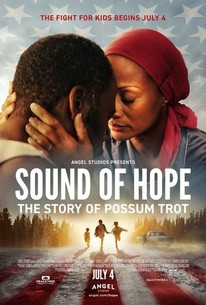
Sound of Hope: The Story of Possum Trot
2024, PG-13, 2h 10m
Genres
Director
Joshua Weigel
Writers
Joshua Weigel, Rebekah Weigel
Stars
Nika King, Demetrius Grosse, Elizabeth Mitchell
Inspired by a true story, a rural East Texas pastor and his wife ignite a movement within their small church to adopt 77 of the most difficult-to-place children in the foster system.
☕Thus says AI: 82/100
⭐ Rating: Thus Says AI –
This approval rating reflects the film’s genuine portrayal of sacrificial love, theological depth in exploring suffering and redemption, and artistic courage in refusing to sanitize the brutal realities of foster care trauma. While it occasionally leans on earnest narration, the performances and authentic faith representation elevate it above typical faith-based fare.
📊 Review Summary
| Concern | Level | Notes |
|---|---|---|
| Violence | Moderate-High | Domestic violence scene with shooting (discreet but disturbing); photos of abused children with bruises and burns; spanking scene; intense 911 call |
| Language | Low | Mild profanity including “bitch,” “ass,” “hell”; sincere uses of “Jesus” and “Lord” |
| Drug Use | Low | References to crack houses and drug addiction; no on-screen use |
| Explicit Content | Low-Moderate | Implied sexual encounter between teens (clothing falls); references to child prostitution and sexual abuse; nothing graphic |
| Spiritual Messaging | Strong Positive | Authentic Christian faith drives narrative; prayer, Scripture, church community central; no proselytizing |
| Verdict | Watch | Powerful testimony to James 1:27 faith in action; not for young teens due to intense content |
🎬 Sound of Hope in a Nutshell
🔤 Title: Sound of Hope: The Story of Possum Trot
🎬 Director: Joshua Weigel
📺 Genre: Faith-Based Drama / Biographical
⏱️ Runtime: 129 minutes
📅 Release: July 4, 2024
⭐ Rating: PG-13 (Thematic material involving child abuse, violence, language, brief suggestive content)
🎭 Stars: Nika King, Demetrius Grosse, Elizabeth Mitchell, Diaana Babnicova
📖 Based on: True story of Bennett Chapel Missionary Baptist Church, Possum Trot, Texas
🏆 Executive Producer: Letitia Wright (Black Panther)
🎥 Distributor: Angel Studios
🎬 Plot Synopsis
Grief cracks Donna Martin wide open. After her mother’s death in 1996, the First Lady of Bennett Chapel in Possum Trot, Texas, spirals into depression. Two years later, while walking through the piney woods, she hears God’s unmistakable whisper: adopt.
Her husband, Reverend WC Martin, initially balks. “Human ones?” he jokes when Donna shares her calling. But God softens his heart too. Together, they attend a foster care orientation that shatters their assumptions. Children covered in bedbug bites. Kids rescued from crack houses. A little girl “pimped out” by her own mother.
“We just can’t look away,” Donna declares.
The Martins adopt Tyler and Mercedes, siblings scarred by witnessing their mother’s murder. Then comes Terri, a 12-year-old with trauma so deep that multiple families have rejected her. WC preaches adoption from the pulpit. One by one, families step forward. The poor, working-class congregation of 22 families ultimately welcomes 77 children nobody else wanted.
But love isn’t magic. It’s messy. Terri fights, runs away, acts out sexually. Bills pile up. Parents reach breaking points. The film doesn’t offer easy answers, only honest ones: redemption requires walking through valleys, not around them.
💭 Themes & Messages of Sound of Hope
1. Pure Religion: James 1:27 Lived Out
The film incarnates James’s definition of “pure and undefiled religion” caring for orphans in distress. Possum Trot doesn’t theorize about orphan care. They do it. WC’s sermon echoes this: “If we can’t wrap our arms around the most vulnerable among us…” he challenges, leaving the question hanging like conviction in the air.
Biblical Resonance: This mirrors the early church’s radical reputation for rescuing abandoned infants from Roman garbage heaps. Christianity has always been countercultural in its orphan advocacy. The Martins embody 1 John 3:18: “Let us not love in word or talk but in deed and in truth.” Their love isn’t sentimental. It’s sacrificial, costly, and transformative.
2. God’s Call Disrupts Comfort
Donna’s calling arrives during her darkest moment. God doesn’t wait for her to heal before commissioning her. He uses her brokenness as the catalyst. WC faces his own disruption when he realizes God is asking more than he volunteered.
Biblical Resonance: Like Moses at the burning bush, who protests his inadequacy, or Jonah, who runs from divine assignment, the Martins initially resist. WC even suggests Donna get a pet instead. But Jeremiah 29:11 promises plans that prosper, not plans that feel easy. God’s purposes often require our yes before revealing the why.
3. The Black Church as Agent of Justice
The film celebrates the historical role of African American churches as engines of social change. Bennett Chapel’s congregation doesn’t merely worship. They move. Their adoption crusade extends the Black church’s legacy from the Civil Rights movement into foster care advocacy.
Biblical Resonance: The early church in Acts 2:44-45 held possessions in common and gave to anyone in need. Possum Trot’s collective action mirrors this communal mission. They’re not isolated heroes but a body functioning as 1 Corinthians 12:12-27 describes, each member essential to the whole.
4. Suffering as Path to Glory
WC quotes James 1:2-4 in a pivotal sermon: count trials as joy because they produce steadfastness. The families don’t avoid valleys. They march straight through them, trusting God’s presence (Psalm 23:4).
Biblical Resonance: This theology challenges prosperity gospel thinking. Romans 8:17 clarifies we’re heirs “provided we suffer with him in order that we may also be glorified with him.” Possum Trot experiences this paradox: their greatest struggles birth their deepest joy. Like Paul’s thorn, suffering becomes the space where God’s grace proves sufficient.
5. Wealth Redefined
Possum Trot ain’t rich. The Martins balance checkbooks nervously. Yet they possess wealth that escapes the prosperous white church WC visits for help. When that pastor cites budget constraints for a million-dollar building campaign, the contrast stings.
Biblical Resonance: Jesus’s parable of the widow’s mite (Mark 12:41-44) finds embodiment here. The poor give more because they give from need, not excess. Matthew 19:23-24 warns about wealth’s spiritual dangers. Possum Trot’s material poverty becomes spiritual advantage, freeing them to risk everything for Kingdom purposes.
6. Moses as Adoption Archetype
WC preaches about Moses, adopted by Pharaoh’s daughter, who later freed his people. This typology reframes adoption theologically.
Biblical Resonance: Exodus 2:1-10 shows adoption as God’s method for positioning his deliverer. More profoundly, Romans 8:15 and Galatians 4:4-7 reveal all believers are adopted into God’s family. We’re spiritual foster kids rescued from darkness. The film’s adoptions mirror our salvation story: chosen, loved, grafted into family we didn’t earn.
🎞️ Scene Examples & Biblical Analysis
1. The Orientation Presentation
Susan (Elizabeth Mitchell) presents photos of abused children during the adoption orientation. Donna sees a child covered in bedbug bites, another with bruises, yet another rescued from prostitution. The camera holds on Donna’s face as horror and conviction wash over her. “We just can’t look away,” she whispers.
Biblical Analysis: This scene embodies Proverbs 24:11-12: “Rescue those who are being taken away to death; hold back those who are stumbling to the slaughter.” The passage warns against excusing inaction by claiming ignorance. Once Donna sees, she cannot unsee. Her response mirrors the Good Samaritan (Luke 10:25-37), who, unlike religious leaders, sees the wounded man and acts with costly compassion. The scene challenges viewers: what do we refuse to look away from?
2. Tyler and Mercedes’s Arrival
Two traumatized children enter the Martin home. Mercedes, who witnessed her mother’s murder, immediately calls Donna “Mama.” Tyler, shell-shocked, remains silent. Donna welcomes them with a declaration: “Our God is a good God.”
Biblical Analysis: This moment reflects Isaiah 49:15-16: even if mothers forget their children, God will not. Donna becomes God’s hands to children whose biological families failed them. The instant adoption of “Mama” also parallels John 1:12, where believers receive authority to become God’s children the moment they receive Christ. Family status changes immediately, even while transformation unfolds gradually.
3. Terri’s Bathroom Stall Incident
Terri, dressed provocatively, leads a boy into a school bathroom. We see clothing drop. Afterward, she weeps with shame. The scene is discreet but devastating because we understand: she’s reenacting her abuse, the only love language she knows.
Biblical Analysis: This portrays the warped theology abuse creates. Terri has internalized lies about her worth and God’s character. She resembles Hosea’s Gomer, running back to destructive patterns despite covenant love pursuing her. Yet Psalm 34:18 promises God is “near to the brokenhearted and saves the crushed in spirit.” Terri’s brokenness doesn’t disqualify her from redemption. It qualifies her. Her eventual transformation demonstrates 2 Corinthians 5:17: new creation doesn’t erase scars but redeems them.
4. Donna’s Spanking of Terri
When Terri pushes boundaries, Donna spanks her in frustration. It’s not abuse, but it’s not grace either. Donna later realizes she’s responded from exhaustion, not love. The film doesn’t excuse it or vilify it. It simply shows two broken people colliding.
Biblical Analysis: This scene’s honesty is rare in Christian cinema. Donna isn’t a saint. She’s a 2 Corinthians 4:7 “jar of clay” containing treasure but cracking under pressure. Galatians 6:1-2 instructs restoring others gently while watching ourselves. Donna’s failure and subsequent growth model this. She illustrates Philippians 2:12-13, working out salvation with fear and trembling because God works within her.
5. “You’re My Daughter Too”
After Terri runs away, Donna finds her. Instead of lecturing, she speaks identity: “You’re my daughter too. I’m not giving up on you, but you can’t give up on me either.”
Biblical Analysis: This mirrors the father’s speech to the elder brother in Luke 15:31-32: “Son, you are always with me, and all that is mine is yours.” Donna declares covenant love. Not if Terri behaves, but because she’s been chosen. This reflects Romans 5:8: Christ died for us while we were still sinners. Before Terri earns it. Before she believes it. Before she can reciprocate. Unconditional love precedes transformation.
6. WC’s Visit to the Wealthy Church
WC approaches a prosperous white church for help. The pastor, played by director Joshua Weigel, explains they’re raising funds for a million-dollar capital campaign. No money for orphans, but plenty for buildings.
Biblical Analysis: Jesus’s temple-cleansing (John 2:13-17) and condemnation of religious leaders who “devour widows’ houses” (Mark 12:40) echo here. The scene indicts institutional Christianity’s frequent priority inversion. Micah 6:8 demands justice, mercy, and humility, not monuments. Matthew 25:40 warns: whatever we fail to do for “the least of these,” we fail to do for Christ himself.
7. Terri’s Baptism
The film’s emotional climax arrives at Terri’s baptism. She emerges from the water, surrounded by her church family, finally believing she belongs.
Biblical Analysis: Baptism symbolizes death and resurrection (Romans 6:3-4). Terri’s old identity, formed by abuse, drowns. She rises as God’s daughter, defined by love. This moment fulfills Isaiah 43:1-2: “Fear not, for I have redeemed you; I have called you by name, you are mine. When you pass through the waters, I will be with you.” The community’s presence reinforces Hebrews 10:24-25‘s call to gather, encouraging one another. Terri’s transformation happens within covenant community, not isolated therapy.
⚠️ Content Warnings
Violence
- Domestic violence scene: A woman is slapped and shot by her boyfriend while her children hide in the bathroom. The violence is not graphic but clearly depicted and deeply disturbing
- Child abuse photos: During the orientation, photos show children with bruises, burns, bedbug bites, and other signs of severe neglect
- 911 call scene: A 6-year-old girl calls 911 while her mother is beaten in the next room. Extremely tense and frightening
- Spanking scene: Donna spanks Terri repeatedly during a confrontation. Not abusive but intense
- Implied violence: References to children removed from crack houses, drug-related situations
- Physical altercations: Girls fighting at school; glass thrown and shattered during arguments
Drug & Alcohol Use
- Verbal references: Multiple mentions of children rescued from crack houses and homes with drug-addicted parents
- Smoking: A negative character smokes cigarettes
- No on-screen drug use shown
Profanity
- Mild profanity: “A**,” “b***h” (mostly obscured), “hell,” “ho”
- Religious exclamations: “Jesus,” “Lord Jesus” used frequently but sincerely, not as profanity
- Overall: Language is relatively mild for PG-13 but present
Romantic or Explicit Content
- Implied sexual encounter: Terri enters bathroom stall with teenage boy; clothing falls to floor; nothing explicit shown but sex is clearly implied. Scene includes her subsequent emotional breakdown
- Sexual abuse references: Multiple verbal references to child sexual abuse, including that Terri was raped by her mother’s boyfriend and a child was “pimped out”
- Marital intimacy: Lighthearted scene where WC attempts to seduce Donna (nothing explicit); she’s preoccupied
- Suggestive clothing: Terri dresses provocatively after trauma
- Song of Solomon reference: WC quotes romantic Scripture in marriage context
Spiritual Messaging
- Strongly Christian: Film is explicitly faith-based with authentic Black Baptist church culture
- Prayer throughout: Characters pray for guidance, provision, strength
- Scripture references: Multiple biblical passages quoted and applied
- Divine calling: Donna hears God’s voice directing her to adopt
- Church community central: Worship, sermons, congregational support drive narrative
- Baptism scene: Powerful spiritual climax
- No preaching at viewers: Faith emerges organically from story rather than didactic messaging
- Universal themes: Non-believers can appreciate themes of community, sacrifice, and love while Christians will resonate with explicit faith elements
🎯Verdict
Reasons to Watch ✅
1. Authentic Faith Representation
Christian films often trade realism for sanitized religion. Sound of Hope refuses that bargain. These believers doubt, yell, reach breaking points, yet cling to God. According to Plugged In, the film demonstrates “tenacious commitment” without pretending faith makes hard things easy. This James 1:2-4 theology counting trials as joy because they produce steadfastness resonates with mature Christians who’ve walked difficult paths.
2. Exceptional Performances
Nika King and Demetrius Grosse deliver powerhouse performances as the Martins. The Collision calls this “the most exceptionally acted faith-based film” the reviewer had ever seen. Diaana Babnicova, playing Terri, avoids “troubled teen cliches” with heartbreaking authenticity. These aren’t caricatures. They’re people.
3. Theological Depth Without Preachiness
The film explores profound themes adoption as spiritual metaphor, suffering’s redemptive purpose, communal mission without lecturing. Crosswalk notes it’s a “raw and authentic gospel-centric film where faith is woven through the narrative.” The theology emerges from lived experience, not sermon notes.
4. Honest About Adoption’s Costs
Most Christian films resolve conflicts with tidy bows. Sound of Hope acknowledges adoption’s brutal realities: trauma doesn’t vanish with love, attachment takes years, and parents will want to quit. Geeks Under Grace praises how the film “does not hold back from the heart breaking situations.” This honesty serves potential foster/adoptive families better than false promises.
5. Call to Action That Matters
The film’s concluding challenge is statistical: 100,000 kids need homes. Nearly 400,000 churches exist in America. The math suggests solutions. Christian Today observes the film calls Christians “to be a beacon of light and hope to the weak and most vulnerable.” It might actually change behavior, not just inspire feelings.
6. Celebration of Black Church Legacy
The film honors the Black church’s historic role in justice movements. Bennett Chapel extends that legacy from civil rights to orphan care. Common Sense Media notes it “shows that Black rural life is just as nuanced as urban life” and offers “positive diverse representations” rarely seen in faith films.
7. Hope Without Naivety
The real Terri now thrives as a retail manager and homeowner. Other Possum Trot kids succeeded too. The film balances harsh realities with genuine redemption arcs. It offers hope grounded in actual outcomes, not wishful thinking.
❌ REASONS TO AVOID
1. Too Intense for Sensitive Viewers
If domestic violence, child abuse discussions, or implied sexual assault trigger trauma responses, skip this. Angel Studios’ Foster Family Viewer’s Guide explicitly warns former foster youth found it triggering. The film “goes to the hard places” and “doesn’t allow you to look away.”
2. Not for Young Teens
Despite PG-13 rating, multiple reviewers warn against bringing children. One parent on IMDb wrote, “I was a little horrified about how serious some of the scenes were… This needs more of a PG-15 rating.” If you wouldn’t discuss sexual trafficking and murder with your 13-year-old, don’t bring them.
3. Slow Pacing in Places
Geeks Under Grace notes a “slow introduction and an overreliance on narration-laden montages.” If you prefer tighter editing and faster pacing, this might drag.
4. Earnest to a Fault
Roger Ebert’s site critiques the “po-faced earnestness, syrupy music… and wide-eyed performances dripping with conviction.” If you find most faith films too sincere, this won’t change your mind.
5. Limited Dramatic Conflict
The film focuses on internal struggles rather than external antagonists. Geeks Under Grace observes it “lacks a clear dramatic conflict.” Everyone wants these adoptions to succeed. If you need sharper narrative tension, this may feel undramatic.
💭 Final Thoughts
Sound of Hope: The Story of Possum Trot is the rare Christian film that trusts audiences with complexity. It doesn’t promise that faith makes hard things easy. It promises God walks through valleys with us.
The film’s greatest strength lies in its refusal to offer easy answers. Terri’s transformation isn’t instant. Donna nearly breaks. Bills still need paying. Yet grace persists. Not as magic wand, but as stubborn presence.
For adult Christians wrestling with what James 1:27 faith looks like in flesh and blood, this film offers prophetic witness. Possum Trot didn’t theorize about orphan care. They bled for it.
The closing statistics haunt intentionally: 100,000 kids waiting. 400,000 churches existing. The math suggests culpability. “If we can do this in Possum Trot with the little we had,” Bishop Martin challenges, “what can we do if we all come together?”
That question lingers long after credits roll.
Some will dismiss this as faith-based sentimentality. Let them. The 77 children now thriving as adults tell a different story. So do the thousands of families who’ve launched adoption journeys after hearing Possum Trot’s witness.
Watch this film if: You want your faith challenged more than comforted. You can handle brutal honesty about trauma and redemption. You’re ready for stories that might change how you live, not just how you feel.
Skip this film if: You need lighter fare. Violence and abuse references will overwhelm you. You prefer action over internal character journeys.
For those willing to sit with discomfort, Sound of Hope offers something increasingly rare: authentic faith wrestling with real darkness and discovering light doesn’t dispel shadows by ignoring them, but by walking straight through them.
The Martins and their community didn’t play it safe. They risked everything for the least of these. Their story asks: Will we?
Explore Latest Book Reviews
-
Unbroken: A World War II Story of Survival, Resilience, and Redemption
Unbroken: A World War II Story of Survival, Resilience, and Redemption 2010, Pages: 528 Genres Writer Laura Hillenbrand Characters Louie Zamperini, Russell Allen Phillips, Pete Zamperini An Olympic runner turned WWII bombardier survives a plane crash, 47 days at sea, and brutal torture as a POW, only to face his hardest battle at home: forgiving…
-
Silence
Silence 1966, Reading Time: 8-10h, Pages: 300 Genres Writer Shūsaku Endō Characters Sebastião Rodrigues, Cristóvão Ferreira, Kichijiro, Tokugawa Inoue Two 17th-century Jesuit priests journey to a Japan hostile to their faith to locate their missing mentor, only to face a test that questions the very nature of God’s presence in suffering. ☕Thus says AI: 89/100…
-
Apocalyptic | Books | Christian Fiction | Christianity | Dystopian | Fantasy | Fiction | Religion | Science Fiction | Suspense/Thriller
Left Behind: A Novel of the Earth’s Last Days
Left Behind: A Novel of the Earth’s Last Days 1995, 5h 21m Genres Authors Jerry B. Jenkins, Larry LaHaye “In the blink of an eye, millions vanished—now, the real nightmare begins for those who stayed.” ☕Our No Cap Review Left Behind in a Nutshell Left Behind is a 1995 novel by evangelical pastor Tim LaHaye and…
-
Books | Christian | Christian Living | Christian Non Fiction | Christianity | Evangelism | Faith | NonFiction | Religion
Gospeler
Gospeler: Turning Darkness into Light One Conversation at a Time Willie Robertson (author) A bold, heartfelt call to share the hope of Jesus through simple conversations that can change a life forever. Genres 224 pages, Paperback First published May 14, 2024 Our No Cap Review Plot Summary Gospeler is Willie Robertson’s personal and practical exploration…
-
Books | Business | Communication | Leadership | Management | NonFiction | Personal Development | Personal Growth | Psychology | Self Help
Never Split the Difference: Negotiating As If Your Life Depended on It
Never Split the Difference: Negotiating As If Your Life Depended on It Chris Voss (Author), Tahl Raz (co-author) Never Split the Difference is a bestselling negotiation book written by former FBI lead international hostage negotiator Chris Voss, with journalist Tahl Raz. Drawing from real high-stakes hostage scenarios, corporate negotiations, and cross-cultural conflict resolution, Voss presents…
-
The Hobbit
Middle-earth #0 The Hobbit, or There and Back Again J. R. R. Tolkein The Hobbit is a timeless fantasy adventure that follows Bilbo Baggins, a comfort-loving hobbit from the peaceful Shire, who is unexpectedly swept into a daring quest. When the wizard Gandalf arrives at his doorstep with thirteen determined dwarves led by Thorin Oakenshield,…



Explore Latest Movie Reviews
-
The King of Kings
The King of Kings The King of Kings | © 2025 Angel Studios Category None Light Moderate Heavy Profanity ✓ Violence & Gore ✓ Drug & Alcohol Use ✓ Explicit Content ✓ Spiritual Messaging ✓ 2025, 1h 41m Genres Director Seong-ho Jang Writers Seong-ho Jang, Rob Edwards Stars Oscar Isaac, Kenneth Branagh, Uma Thurman, Pierce…
-
Amazing Grace
Amazing Grace 2006, PG, 2h Genres Director Michael Apted Writers Steven Knight Stars Ioan Gruffudd, Albert Finney, Michael Gambon The idealist William Wilberforce maneuvers his way through Parliament in 19th-century England, endeavoring to end the British transatlantic slave trade. Amazing Grace: When Faith Fuels Revolution A Christian Review of the 2006 Biographical Drama 📊 Rating…
-
War Room
War Room 2015, PG, 2h Genres Director Alex Kendrick Writers Alex Kendrick, Stephen Kendrick Stars Priscilla C. Shirer, T.C. Stallings, Karen Abercrombie With her marriage on the brink of collapse, a woman discovers that she can only win the battle for her home by surrendering the fight to God in her “war room.” Is War…
-
God’s Not Dead 2
God’s Not Dead 2 2016, PG, 2h Genres Director Harold Cronk Writers Chuck Konzelman, Cary Solomon Stars Melissa Joan Hart, Jesse Metcalfe, David A.R. White When a public high school teacher is sued for answering a student’s question about Jesus, she must fight in court to save her career and defend the right to speak…
-
God’s Not Dead
God’s Not Dead 2014, PG, 1h 53m Genres Director Harold Cronk Writers Hunter Dennis, Chuck Konzelman, Cary Solomon Stars Shane Harper, Kevin Sorbo, David A.R. White A devout Christian student must prove God’s existence in a series of debates against his atheist philosophy professor to save his grade and stand up for his faith. ☕Thus…
-
Drama | Epic | Historical Epic | History | Movies | Period Drama
Silence
Silence 2003, PG-13, 2h 3m Genres Director Martin Scorsese Writers Jay Cocks, Martin Scorsese, Shûsaku Endô Stars Andrew Garfield, Adam Driver, Liam Neeson Two 17th-century Jesuit priests journey to a Japan hostile to their faith to locate their missing mentor, only to face a test that questions the very nature of God’s presence in suffering….