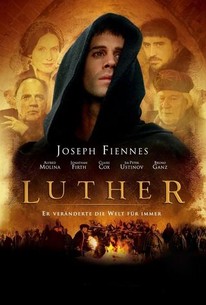
Luther
2003, PG-13, 2h 3m
Genres
Director
Eric Till
Writers
Camille Thomasson, Bart Gavigan
Stars
Joseph Fiennes, Bruno Ganz, Peter Ustinov
Driven by a crisis of faith and armed with the truth, a humble 16th-century monk challenges the Holy Roman Empire and sparks a revolution that changes the world forever.
☕Thus says AI: 82/100
⭐ Rating: Thus Says AI –
This film delivers a compelling, biblically-grounded portrait of one of Christianity’s most pivotal figures. Joseph Fiennes’ nuanced performance anchors a thoughtful meditation on conscience, grace, and the supremacy of Scripture—themes that resonate deeply with evangelical faith. While not flawless historically, Luther stands as one of the most genuinely faith-affirming films in contemporary cinema.
Article Summary
| Concern | Level | Notes |
|---|---|---|
| Violence | Moderate | Brief but intense depictions of dead bodies, hangings, riots; one character burned at stake (off-camera); mostly shows aftermath rather than graphic detail |
| Language | Minimal | Luther curses the devil with “d–ns” and one s-word; otherwise remarkably clean for a historical drama |
| Drug Use | None | No substance abuse depicted |
| Explicit Content | None | A brief scene of Luther and wife in bed (wearing nightclothes); no nudity; minimal sensuality |
| Spiritual Messaging | Highly Positive | Grace-centered theology, Scripture’s authority, God’s mercy vs. judgment, conscience bound by God’s Word, courage in faith |
| Emotional Intensity | Moderate-High | Luther’s spiritual anguish, fear of damnation, internal conflict with institutional authority; themes of isolation and burden |
🎬 Luther in a Nutshell
Imagine a man so tormented by his own sinfulness that he believes God delights in condemning him. Now imagine that same man discovers—through Scripture—that God doesn’t want his condemnation; He wants his faith. That discovery ignites a reformation. This is Luther: a meditation on grace that happens to reshape Western Christianity.
🎬 Plot Synopsis
The year is 1505. A young Augustinian friar named Martin Luther (Fiennes) cowers in a thunderstorm, convinced he’s about to die. In desperation, he vows to Saint Anne: “If you save me, I’ll become a monk.” She does. He does.
But monastic life doesn’t ease Luther’s anguish. Confession after confession, penance after penance—nothing silences his terror of a wrathful God. His superior, Johann von Staupitz (Bruno Ganz), offers cryptic counsel: “Stop looking at yourself. Look to Christ.”
Meanwhile, back in Rome, the papal machine churns. Pope Leo X (Uwe Ochsenknecht) commissions Johann Tetzel (Alfred Molina) to peddle indulgences—certificates promising forgiveness for cold, hard cash. The money funds St. Peter’s Basilica. The souls fund desperation.
When Tetzel arrives in Wittenberg, Luther snaps. Here’s a man scaring poor peasants into financial ruin for pieces of paper. The hypocrisy is staggering. By October 1517, Luther’s had enough. He writes 95 theses questioning indulgences and, according to legend (though probably not historical fact), nails them to the church door.
The document spreads like wildfire. Rome notices. The Pope demands recantation. Luther refuses—first in private, then publicly before the Diet of Worms in 1521, delivering his immortal lines: “Unless I am convinced by Scripture or by plain reason… here I stand, I can do no other. God help me.”
Luther escapes execution, translates the Bible into German so common folk can read it themselves, marries a former nun (Katharina von Bora, played by Claire Cox), and watches the Reformation spread across Europe—along with peasant revolts, violence, and consequences he never intended. By 1530, Lutheran princes at the Diet of Augsburg officially break with Rome. The medieval world fractures.
💭 Themes & Messages of Luther
1. Grace as God’s Scandal 💙
Luther pivots on a stunning theological moment: when does grace stop feeling like weakness and start feeling like liberation?
For most of his life, Luther equates righteousness with achievement. Pray harder. Fast longer. Confess deeper. Perform. Earn. Deserve. But as he studies Scripture—particularly Romans—a revelation ambushes him: [https://www.bibleportal.com/verse-topic?v=Romans%203:23-28&version=ESV](Romans 3:23-28) declares that all are sinners, yet all are justified freely by grace through faith. Not by works. Not by indulgences. By faith alone.
This doctrine—sola fide (faith alone)—isn’t just theological jargon. It’s permission to stop performing and start resting in Christ’s righteousness. The film shows Luther physically lighten as he grasps this truth. His face softens. His shoulders drop. He’s been drowning, and suddenly he realizes the water can hold him.
Biblical Link: This mirrors the paralytic’s four friends in [https://www.bibleportal.com/verse-topic?v=Mark%202:1-12&version=ESV](Mark 2). They couldn’t earn their friend’s healing through personal righteousness—they brought him to the One who heals by grace. Luther finally understands: he doesn’t need to be perfect; he needs Jesus. Evangelically, this is the core of the Gospel.
2. Scripture as Ultimate Authority 📖
One of Luther’s most powerful scenes unfolds at the Diet of Worms (1521). The Archbishop demands: “Will you recant?”
Luther’s response echoes through the centuries: “My conscience is captive to the Word of God.”
This isn’t rebellion dressed in piety. This is a man saying: I have checked my convictions against Scripture. Scripture wins. Everything else bows. He appeals to [https://www.bibleportal.com/verse-topic?v=2%20Timothy%203:16-17&version=ESV](2 Timothy 3:16-17), which declares Scripture is “profitable for teaching, for reproof, for correction, and for training in righteousness.” If popes contradict Scripture, popes are wrong. If traditions contradict Scripture, traditions are wrong.
The film doesn’t make this abstractly intellectual. You feel Luther’s conviction. He’s not performing conviction. He’s living under the weight of it.
Biblical Link: Luther’s stand echoes [https://www.bibleportal.com/verse-topic?v=Acts%205:29&version=ESV](Acts 5:29), where Peter tells the Sanhedrin: “We must obey God rather than men.” Both men faced institutional authority. Both chose Scripture. Both risked death. For evangelicals, this scene is what faithfulness to God’s Word looks like.
3. Conscience as God’s Captive, Not Culture’s Servant ⛓️
Luther’s most dangerous stance isn’t his critique of Rome. It’s his insistence that individual conscience, when bound to God’s Word, supersedes institutional authority.
The medieval church taught: Submit to the hierarchy. Trust the institution. Your private conscience is suspect.
Luther counters: Your conscience must submit to Scripture—but when it does, nothing can force you to violate it.
This is simultaneously radical and deeply evangelical. It’s radical because it dismantles institutional monopolies on truth. It’s evangelical because it roots conscience not in personal whim but in captivity to the Word. You’re not free to believe whatever. You’re captive to what Scripture teaches.
The film shows Luther wrestling with this tension beautifully. He doesn’t want to defy the Church. He loves the institutional Church. But his conscience won’t surrender to it because Scripture won’t let go of him.
Biblical Link: [https://www.bibleportal.com/verse-topic?v=Romans%2014:23&version=ESV](Romans 14:23) teaches that “whatever does not proceed from faith is sin.” For Luther, this meant: if your conscience—bound to Scripture—tells you something is wrong, you must follow it, even at cost. [https://www.bibleportal.com/verse-topic?v=1%20Peter%201:13-16&version=ESV](1 Peter 1:13-16) echoes this: believers are to “gird up your minds” and “be holy” because you’re redeemed. Holiness includes the integrity to follow conscience when it’s tethered to God’s Word.
4. God as Merciful Father, Not Cosmic Accountant 🤝
Early in the film, Luther describes his God like this: “Those who see God as angry… do not see him rightly… But look upon a curtain as if a dark storm cloud has been drawn across his face… if we truly believe that Christ is our savior… then we have a God of love… And to see God in faith is to look upon his friendly heart.”
This is the emotional arc of Luther. He transforms from a man terrified of divine judgment to a man resting in divine love. Not because God changed. Because Luther understood God differently through Scripture.
The film crystallizes this in a pivotal scene: Luther learns that a young boy has hanged himself, tormented by fear of damnation. Luther, weeping, buries him in holy ground—defying church law. Why? Because “God is mercy.” A God who delights in condemning the already-desperate isn’t the God of Scripture. It’s a demon masquerading as God.
Biblical Link: This directly engages [https://www.bibleportal.com/verse-topic?v=Romans%201:17&version=ESV](Romans 1:17), which promises “the righteous will live by faith”—not by fear, not by perfect performance, but by faith in a merciful God. Luther’s breakthrough moment, which the film depicts tenderly, parallels [https://www.bibleportal.com/verse-topic?v=1%20John%204:7-8&version=ESV](1 John 4:7-8): “God is love.” Not angry first. Love first. This reshapes everything.
5. The Tragedy of Unintended Consequences 😔
Here’s where Luther complicates the narrative—and deepens it. Luther doesn’t mean to spark the Peasants’ Revolt. He doesn’t intend to fragment Christendom. He’s trying to reform the Church from within.
But his words carry power he can’t contain. Revolutionaries misuse his theology of freedom. Peasants die by the tens of thousands. Luther watches in horror and pronounces himself “a man of blood.”
The film doesn’t shield us from this. Luther is neither saint nor villain—he’s a flawed human whose convictions, however biblically grounded, have consequences he can’t control and partly caused. He laments: “People look to me as a fixed star but I am not. I am a wandering planet. No one should look to me for guidance.”
Biblical Link: This echoes [https://www.bibleportal.com/verse-topic?v=1%20Timothy%203:6&version=ESV](1 Timothy 3:6), which warns against the pride that comes from position. It also resonates with [https://www.bibleportal.com/verse-topic?v=James%203:1&version=ESV](James 3:1), which cautions that “those who teach will be judged with greater strictness.” Luther knows this weight. The film honors that knowledge without excusing him.
🎞️ Scene Examples & Biblical Analysis
Scene 1: The Thunderstorm (Opening)
Young Luther, caught in a violent storm, screams prayers to Saint Anne in terror. When lightning strikes nearby, he vows: “Saint Anne, save me, and I will become a monk!”
Analysis: This scene establishes Luther’s fundamental problem: he believes God is a cosmic executioner waiting for the moment to strike. Fear, not love, drives him to God. The film uses stunning cinematography—wind, thunder, lightning—to externalize his internal terror. It’s a perfect visual metaphor for spiritual anguish.
Biblical Note: [https://www.bibleportal.com/verse-topic?v=1%20John%204:18&version=ESV](1 John 4:18) teaches that “perfect love casts out fear.” Luther’s journey is toward understanding this truth experientially.
Scene 2: Tetzel’s Indulgence Sales Pitch
Johann Tetzel (Alfred Molina) arrives in Wittenberg and orchestrates a masterclass in psychological manipulation. He terrifies parishioners with graphic descriptions of purgatorial torment, then offers them a solution: “For a small donation, this certificate will spare your loved one from flames.”
We see an old woman empty her meager savings. A widow sells her inheritance. Luther watches, seething.
Analysis: Molina’s performance is disturbingly charismatic. Tetzel isn’t a cartoonish villain; he’s an effective salesman who believes his own pitch. But the mechanism is predatory: exploit fear, offer false hope, extract wealth. Luther’s critique is pastoral: this destroys faith because it replaces trust in God’s mercy with trust in institutional machinery.
Biblical Link: This directly violates [https://www.bibleportal.com/verse-topic?v=Ephesians%204:28&version=ESV](Ephesians 4:28), which forbids “any unwholesome talk” and commands that speech “build up the one who is listening.” More fundamentally, it perverts [https://www.bibleportal.com/verse-topic?v=1%20Timothy%206:10&version=ESV](1 Timothy 6:10): “The love of money is a root of all kinds of evil.” The Church has weaponized financial need against spiritual desperation. Luther’s rage is righteous.
Scene 3: Luther’s Breakthrough in Romans
In his study, late at night, Luther reads Romans 3 by candlelight. Fiennes’ face shifts—from confusion to recognition to profound relief. He whispers: “Not by works. By faith. Grace alone.”
His superior, Staupitz, watches and nods. “You finally understand,” the old man says gently.
Analysis: This is the heart of Luther—the moment he stops performing righteousness and starts receiving it. The film doesn’t dramatize this with explosions. It’s intimate, quiet, true. You see a man’s entire spiritual universe realign.
Biblical Foundation: Luther is specifically grasping [https://www.bibleportal.com/verse-topic?v=Romans%203:23-28&version=ESV](Romans 3:23-28):
“For all have sinned and fall short of the glory of God, and all are justified freely by his grace through the redemption that came by Christ Jesus.”
For evangelicals, this is the Gospel in a single passage. Luther’s breakthrough is your breakthrough too.
Scene 4: The Diet of Worms (The “Here I Stand” Speech)
Emperor Charles V, surrounded by princes and bishops, demands Luther recant. Luther’s allies have disappeared. He stands alone, facing the most powerful institution in Christendom.
He refuses. Not with arrogance. With trembling conviction.
“Unless I am convinced by the testimony of the Holy Scriptures or by evident reason… my conscience is captive to the Word of God. Thus I cannot and will not recant, because acting against one’s conscience is neither safe nor sound. God help me. Amen.”
Analysis: This is cinema at its most powerful. Fiennes doesn’t deliver this as a hero’s speech. He delivers it as a man facing probable death, choosing obedience to Scripture over self-preservation. The camera pulls back; the room feels cavernous and hostile. Luther’s isolation is absolute.
Yet he doesn’t look isolated. He looks grounded. His conscience is captive not to fear but to God’s Word.
Biblical Parallel: Peter and John before the Sanhedrin ([https://www.bibleportal.com/verse-topic?v=Acts%204:18-20&version=ESV](Acts 4:18-20)):
“Peter and John replied, ‘Which is right in God’s eyes: to listen to you, or to him? You be the judges! As for us, we cannot help speaking about what we have seen and heard.'”
Both men chose witnessing to Christ over institutional pressure. Both risked death. Both refused to silence conscience when conscience was bound to God’s Word.
Scene 5: Luther’s Lament Over the Peasants’ Revolt
Late in the film, Luther learns that over 100,000 peasants have been slaughtered by German princes. The peasants had claimed to follow his teachings about Christian freedom. They’d burned monasteries and churches.
Luther, devastated, confesses: “I am a man of blood.”
The implication is complex: Luther didn’t cause the revolt directly, but his language—about freedom, about the Bible accessible to all people, about resisting unjust authority—has been weaponized. He never intended this. He’s horrified by it. Yet he can’t escape moral complicity.
Analysis: This scene resists simplistic moralizing. It acknowledges that good theology doesn’t guarantee good outcomes. Ideas have consequences, some unintended. Luther must live with that weight.
Theological Note: [https://www.bibleportal.com/verse-topic?v=Romans%2014:21&version=ESV](Romans 14:21) warns: “It is better not to eat meat or drink wine or to do anything else that will cause your brother or sister to stumble.” Luther’s theology is correct, but its application by others has led to bloodshed. He must grapple with the limits of his influence and the responsibility that comes with it.
⚠️ Content Warnings
Violence
- Level: Moderate. Brief but present.
- Details: Several dead bodies shown (including hanging victims, one suicide); a character is burned at the stake (flames shown, then camera cuts away); crowds riot and people are shoved; Tetzel deliberately burns his hand over a flame to illustrate “hellfire” (charred flesh visible); one character is burned to death (partially shown).
- Note: Violence is generally implied or shown in aftermath rather than graphically. No gratuitous gore. A historically-aware film depicting a violent, turbulent era.
Drug & Alcohol Use: None ✅
Profanity: ✅ Minimal
- Level: Minimal. Remarkably clean.
- Details: Luther curses the devil with “d–ns” (censored form of “damns”) and one s-word. That’s essentially it in a 2-hour film. No f-words, no casual blasphemy.
- Evangelical Note: The minimal profanity actually heightens the two instances where it occurs—they feel earned, not gratuitous.
Romantic or Explicit Content: ✅ Minimal
- Level: None to minimal.
- Details: Luther and Katharina are shown in bed together (clothed in nightwear); no nudity, no sexual content beyond the implication they’re married. Prostitutes are mentioned as part of Rome’s corruption (and briefly visible in crowd scenes). [https://www.bibleportal.com/verse-topic?v=Ephesians%205:25-33&version=ESV](Ephesians 5:25-33), which elevates marriage as Christ’s relationship to the Church, is subtly honored by Luther’s portrayal of his marriage to Katharina as a covenantal partnership, not a carnal arrangement.
🎯Verdict: Reasons To Watch
Reasons to Watch ✅
- It Takes Faith Seriously. In an era when Hollywood either ignores Christianity or caricatures it, Luther treats theology as the driving force of human conviction and courage. Grace isn’t a plot device; it’s the film’s theological heart.
- Joseph Fiennes’ Performance. Fiennes portrays Luther not as a hero but as a human—conflicted, fearful, yet ultimately obedient. His transformation from spiritual terror to grounded faith is deeply moving. You believe him because he doesn’t perform belief; he wrestles with it.
- Historical Grounding. Much of the dialogue is historically documented. Luther’s words—especially at the Diet of Worms—carry the weight of actual history. The film doesn’t invent drama; it lets history’s inherent drama speak.
- Conscience as a Biblical Category. For evangelicals navigating cultural pressure to compromise convictions, Luther is a masterclass. It shows what it looks like to let Scripture bind your conscience and to refuse to violate that binding—even at cost. [https://www.bibleportal.com/verse-topic?v=Romans%2014:23&version=ESV](Romans 14:23) comes alive.
- Grace as Scandal and Solution. The film crystallizes the Reformation’s core insight: salvation isn’t something you earn through works, suffering, or institutional mediation. It’s something you receive through faith. This truth—sola fide—has shaped evangelical theology for 500 years. Seeing it dramatized is powerful.
- It Honors Scripture’s Centrality. Luther’s entire stand pivots on [https://www.bibleportal.com/verse-topic?v=2%20Timothy%203:16-17&version=ESV](2 Timothy 3:16-17). The film shows why evangelicals believe Scripture is the ultimate authority for faith and practice. It’s not abstract; it’s lived.
- Nuance and Complexity. The film doesn’t pretend Luther is perfect. It shows his anguish, his regret, his moral burden. This complexity makes him believable in a way hagiography never could.
Explore Latest Book Reviews
-
Unbroken: A World War II Story of Survival, Resilience, and Redemption
Unbroken: A World War II Story of Survival, Resilience, and Redemption 2010, Pages: 528 Genres Writer Laura Hillenbrand Characters Louie Zamperini, Russell Allen Phillips, Pete Zamperini An Olympic runner turned WWII bombardier survives a plane crash, 47 days at sea, and brutal torture as a POW, only to face his hardest battle at home: forgiving…
-
Silence
Silence 1966, Reading Time: 8-10h, Pages: 300 Genres Writer Shūsaku Endō Characters Sebastião Rodrigues, Cristóvão Ferreira, Kichijiro, Tokugawa Inoue Two 17th-century Jesuit priests journey to a Japan hostile to their faith to locate their missing mentor, only to face a test that questions the very nature of God’s presence in suffering. ☕Thus says AI: 89/100…
-
Apocalyptic | Books | Christian Fiction | Christianity | Dystopian | Fantasy | Fiction | Religion | Science Fiction | Suspense/Thriller
Left Behind: A Novel of the Earth’s Last Days
Left Behind: A Novel of the Earth’s Last Days 1995, 5h 21m Genres Authors Jerry B. Jenkins, Larry LaHaye “In the blink of an eye, millions vanished—now, the real nightmare begins for those who stayed.” ☕Our No Cap Review Left Behind in a Nutshell Left Behind is a 1995 novel by evangelical pastor Tim LaHaye and…
-
Books | Christian | Christian Living | Christian Non Fiction | Christianity | Evangelism | Faith | NonFiction | Religion
Gospeler
Gospeler: Turning Darkness into Light One Conversation at a Time Willie Robertson (author) A bold, heartfelt call to share the hope of Jesus through simple conversations that can change a life forever. Genres 224 pages, Paperback First published May 14, 2024 Our No Cap Review Plot Summary Gospeler is Willie Robertson’s personal and practical exploration…
-
Books | Business | Communication | Leadership | Management | NonFiction | Personal Development | Personal Growth | Psychology | Self Help
Never Split the Difference: Negotiating As If Your Life Depended on It
Never Split the Difference: Negotiating As If Your Life Depended on It Chris Voss (Author), Tahl Raz (co-author) Never Split the Difference is a bestselling negotiation book written by former FBI lead international hostage negotiator Chris Voss, with journalist Tahl Raz. Drawing from real high-stakes hostage scenarios, corporate negotiations, and cross-cultural conflict resolution, Voss presents…
-
The Hobbit
Middle-earth #0 The Hobbit, or There and Back Again J. R. R. Tolkein The Hobbit is a timeless fantasy adventure that follows Bilbo Baggins, a comfort-loving hobbit from the peaceful Shire, who is unexpectedly swept into a daring quest. When the wizard Gandalf arrives at his doorstep with thirteen determined dwarves led by Thorin Oakenshield,…



Explore Latest Movie Reviews
-
The King of Kings
The King of Kings The King of Kings | © 2025 Angel Studios Category None Light Moderate Heavy Profanity ✓ Violence & Gore ✓ Drug & Alcohol Use ✓ Explicit Content ✓ Spiritual Messaging ✓ 2025, 1h 41m Genres Director Seong-ho Jang Writers Seong-ho Jang, Rob Edwards Stars Oscar Isaac, Kenneth Branagh, Uma Thurman, Pierce…
-
Amazing Grace
Amazing Grace 2006, PG, 2h Genres Director Michael Apted Writers Steven Knight Stars Ioan Gruffudd, Albert Finney, Michael Gambon The idealist William Wilberforce maneuvers his way through Parliament in 19th-century England, endeavoring to end the British transatlantic slave trade. Amazing Grace: When Faith Fuels Revolution A Christian Review of the 2006 Biographical Drama 📊 Rating…
-
War Room
War Room 2015, PG, 2h Genres Director Alex Kendrick Writers Alex Kendrick, Stephen Kendrick Stars Priscilla C. Shirer, T.C. Stallings, Karen Abercrombie With her marriage on the brink of collapse, a woman discovers that she can only win the battle for her home by surrendering the fight to God in her “war room.” Is War…
-
Sound of Hope: The Story of Possum Trot
Sound of Hope: The Story of Possum Trot 2024, PG-13, 2h 10m Genres Director Joshua Weigel Writers Joshua Weigel, Rebekah Weigel Stars Nika King, Demetrius Grosse, Elizabeth Mitchell Inspired by a true story, a rural East Texas pastor and his wife ignite a movement within their small church to adopt 77 of the most difficult-to-place…
-
God’s Not Dead 2
God’s Not Dead 2 2016, PG, 2h Genres Director Harold Cronk Writers Chuck Konzelman, Cary Solomon Stars Melissa Joan Hart, Jesse Metcalfe, David A.R. White When a public high school teacher is sued for answering a student’s question about Jesus, she must fight in court to save her career and defend the right to speak…
-
God’s Not Dead
God’s Not Dead 2014, PG, 1h 53m Genres Director Harold Cronk Writers Hunter Dennis, Chuck Konzelman, Cary Solomon Stars Shane Harper, Kevin Sorbo, David A.R. White A devout Christian student must prove God’s existence in a series of debates against his atheist philosophy professor to save his grade and stand up for his faith. ☕Thus…