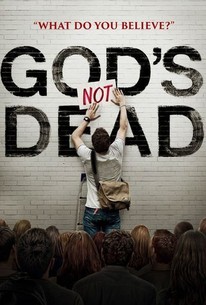
God’s Not Dead
2014, PG, 1h 53m
Genres
Director
Harold Cronk
Writers
Hunter Dennis, Chuck Konzelman, Cary Solomon
Stars
Shane Harper, Kevin Sorbo, David A.R. White
A devout Christian student must prove God’s existence in a series of debates against his atheist philosophy professor to save his grade and stand up for his faith.
☕Thus says AI: 72/100
⭐ Rating: Thus Says AI –
This is a deliberately chosen critical rating reflecting the film’s artistic and theological complexity, not merely its evangelical reception. The film excels in presenting classical apologetics and the courage required to confess Christ publicly. Yet it falters in philosophical nuance and nuanced portraiture of skepticism. A competent Christian drama that sparkles in moments of genuine spiritual challenge, even if it doesn’t sustain intellectual depth throughout.
Review Summary
| Concern | Level | Notes |
|---|---|---|
| Violence | Moderate | Father strikes daughter twice, throttles her, throws her out; man hit by car (fatal); emotional intensity in several scenes |
| Language | None | Clean dialogue throughout; no profanity |
| Drug Use | Minimal | Wine served at dinner; beer mentioned once; no drug use depicted |
| Explicit Content | Minimal | Cleavage visible in one scene; cohabitation implied but not shown; kissing/hugging between couples |
| Spiritual Messaging | Strong (Positive) | Robust Christian message; multiple conversions; emphasis on faith defense and witness; no theological heresy |
🎬 God’s Not Dead in a Nutshell
🔤 Title: God’s Not Dead
🎬 Director: Harold Cronk
📺 Genre: Christian Drama / Apologetics
⏱️ Runtime: 110 minutes
📅 Release: March 21, 2014
⭐ MPAA Rating: PG (Thematic material, brief violence, accident scene)
🎭 Stars: Shane Harper (Josh Wheaton), Kevin Sorbo (Prof. Jeffrey Radisson), David A.R. White (Rev. Dave), Dean Cain (Mark), Cassidy Gifford (Kara)
📖 Based on: Rice Brookes’ apologetics book God’s Not Dead: Evidence for God in an Age of Uncertainty
🎬 Plot Synopsis
College freshman Josh Wheaton enrolls in an introductory philosophy course expecting a standard academic experience. Instead, Professor Jeffrey Radisson—an aggressive atheist—demands that every student sign a statement declaring “God is dead” to pass the class.
Josh refuses.
Rather than simply failing him, Radisson issues a challenge: Josh gets three debate sessions (twenty minutes each, at the end of subsequent classes) to convince the entire class that God exists. The class will vote as jury.
What unfolds is a theological gauntlet. Josh isn’t simply defending his faith—he’s risking his GPA, his relationship with his girlfriend Kara (who abandons him out of fear), and his future law school prospects. Meanwhile, ancillary storylines weave through: a young Muslim woman (Ayisha) secretly converts to Christianity and is disowned by her father; a successful businessman (Mark) cruelly neglects his dying mother; a Christian woman (Mina) breaks up with Radisson after recognizing his spiritual arrogance; and an atheist blogger (Amy) confronts mortality when diagnosed with cancer.
The climax arrives when Josh, in his final presentation, cuts through Radisson’s intellectual posturing with a piercing question: “Why do you hate God?” Radisson explodes with rage, revealing the wound beneath his atheism—his mother died of cancer when he was twelve, and he’s blamed God ever since.
Immediately after, Radisson is struck by a car. As he lies dying on the pavement, Pastor Dave appears (by providential timing) and leads him to Christ in his final moments. The film closes with the class standing and declaring, “God’s not dead.”
💭 Themes & Messages of Luther
1. The Courage to Confess Christ Before the World
Biblical Resonance: The film’s entire narrative architecture rests on Matthew 10:32-33 ESV: “Everyone therefore who acknowledges me before men, I also will acknowledge before my Father who is in heaven, but whoever denies me before men, I also will deny before my Father who is in heaven.” Josh’s refusal to sign the “God is dead” statement—and his willingness to publicly defend God’s existence—embodies this mandate. The film argues that genuine faith cannot remain hidden; it demands public witness, even when costly.
This resonates deeply with evangelical theology: salvation is not merely internal assent but public confession (Romans 10:9). Josh’s struggle models the tension all Christians experience between social comfort and spiritual fidelity.
2. Faith Defended Through Reason & Argument
Biblical Resonance: 1 Peter 3:15 ESV states: “But in your hearts honor Christ as Lord. Always be prepared to give a reason for the hope that is in you.” The film takes this command seriously, filling its debate scenes with classical apologetic arguments—cosmological proofs, fine-tuning, the problem of evil, the moral argument. Josh equips himself with rational defenses, suggesting that faith and intellect need not be adversaries.
However, the film simplifies complex philosophy. It presents arguments in abbreviated form, and some philosophers would argue the film doesn’t adequately address counterarguments. Still, for a lay audience, it communicates that Christians can think critically about their faith.
3. The Problem of Evil & Suffering
Biblical Resonance: Multiple characters grapple with theodicy—the question of why God permits suffering. Radisson’s mother died young. Mina’s mother lives with dementia despite a lifetime of prayer. Amy faces cancer. The film explores both the free-will defense (evil results from human choices, not God’s inaction) and the soul-making theodicy (suffering develops virtue and character).
The film hints at Romans 8:28 without stating it explicitly: “We know that for those who love God all things work together for good, for those who are called according to his purpose.” Yet it stops short of full theological resolution. Mina’s mother’s cryptic comment—that Satan keeps unbelievers comfortable in their sin to prevent their turning to God—is theologically peculiar and unsupported by Scripture.
4. The Cost of Discipleship
Biblical Resonance: Josh loses his girlfriend. Ayisha loses her family. Mina loses her relationship. Each sacrifice echoes Matthew 10:37-39: “Whoever loves father or mother more than me is not worthy of me…and whoever does not take his cross and follow me is not worthy of me.” The film doesn’t romanticize this cost; characters genuinely suffer. Yet the film maintains that following Christ—even when relationships shatter—is worth the price.
5. Transformation Through Encounter with Truth
Biblical Resonance: Multiple characters experience conversion or spiritual renewal by encountering the living God. Ayisha, Martin, Amy, and Radisson all move toward faith. This embodies the evangelical conviction that truth is not abstract doctrine but a person—Jesus Christ. John 14:6: “Jesus said to him, ‘I am the way, and the truth, and the life.'” The film suggests that when people genuinely encounter this truth—through argument, suffering, or grace—they cannot remain unmoved.
6. The Church’s Role in Supporting Individual Faith
Biblical Resonance: Pastor Dave functions as a spiritual anchor for Josh, Ayisha, and others. His pastoral counsel—“Don’t be clever. Be content to tell the truth”—models the church’s role not as fortress or institution, but as community of care and truthfulness. This aligns with Hebrews 10:24-25: the gathered church exhorts and encourages one another.
🎞️ Scene Examples & Biblical Analysis
1. Josh’s Refusal to Sign (Opening Sequence)
Scene: Professor Radisson distributes signed statements saying “God is dead.” When Josh refuses, Radisson offers him a choice: sign or debate publicly.
Biblical Analysis: This scene crystallizes the film’s thesis. Josh’s refusal enacts 1 John 2:15-17—a refusal to conform to the “world” even when it’s academically safer to do so. It also raises a profound question: Can faith be authentic if it’s never tested? The early church fathers would recognize Josh’s stance as marturia—martyrdom or witnessing. He’s willing to lose academic standing for his convictions.
Theological Depth: The film suggests that genuine faith requires decision. Søren Kierkegaard argued that true Christianity demands a “leap of faith”—not blind irrationality, but commitment beyond what reason alone can justify. Josh must choose: comfort or conviction.
2. Josh’s Final Debate: “Why Do You Hate God?” (Climax)
Scene: After two intellectually engaged debates, Josh pivots from argument to confrontation. He asks Radisson point-blank: “Why do you hate God?” When Radisson denies this, Josh repeats the question twice more. Finally, Radisson erupts, confessing that he despises God because God “took everything” when his mother died.
Josh then delivers the philosophical knockout: “How can you hate someone who doesn’t exist?”
Biblical Analysis: This scene operates on multiple theological levels:
- Confession as Grace: Radisson’s explosion is his confession—he moves from intellectual denial to emotional honesty. This mirrors Romans 10:9: confession precedes salvation. By admitting his hatred, Radisson opens the door to transformation.
- The Limits of Rationalism: Josh’s closing argument—“How can you hate God if He’s dead?”—exposes a logical inconsistency in Radisson’s position. This embodies the evangelical conviction that atheism, when examined, contains internal contradictions. If God doesn’t exist, one shouldn’t feel toward Him at all; yet Radisson’s visceral hatred betrays a deep, unacknowledged belief.
- The Problem of Evil Revisited: Radisson’s pain is real. His mother’s death was tragic. The film doesn’t dismiss his grief; it acknowledges it. Yet it suggests that blame misdirected at God (rather than accepted as part of living in a fallen world) becomes corrosive. 1 Peter 5:7 invites believers to cast their anxieties on God because He cares—not because He prevents all suffering.
3. Ayisha’s Disownment (Subplot)
Scene: Ayisha, a Muslim student, secretly converts to Christianity. When her father discovers this, he violently throws her out of the house.
Biblical Analysis: This scene illustrates the cost of conversion across religious boundaries. Ayisha embodies Luke 14:26: “If anyone comes to me and does not hate his own father and mother and wife and children and brothers and sisters, yes, and even his own life, he cannot be my disciple.” This isn’t advocacy for hating family members; it means Christ’s claim supersedes familial loyalty.
Theological Nuance: The film portrays Ayisha’s father’s violence without caricature—his response reflects genuine cultural and religious conflict. Yet it also presents the church (through Pastor Dave) as refuge and family for the displaced. This embodies Psalm 27:10: “Though my father and mother forsake me, the Lord will receive me.”
4. Amy’s Cancer Diagnosis (Subplot)
Scene: Amy, an atheist blogger, is diagnosed with terminal cancer. Her boyfriend Mark abandons her. She confronts the Newsboys backstage and asks for guidance toward faith.
Biblical Analysis: Amy’s conversion illustrates how suffering can shatter worldly confidence and open hearts to transcendence. 2 Corinthians 1:3-4 frames suffering as an avenue for God’s comfort: “Blessed be the God and Father of our Lord Jesus Christ, the Father of mercies and God of all comfort, who comforts us in all our affliction.” Amy’s crisis makes her receptive to this comfort.
Critical Note: Some viewers critique this narrative—does the film suggest that only suffering drives conversion? Evangelical theology resists this. John 6:44 teaches that the Father draws people to Christ; suffering is merely one context in which hearts become receptive.
5. Radisson’s Deathbed Conversion (Ending)
Scene: Radisson is struck by a car. As he bleeds on the pavement, Pastor Dave prays with him. Radisson, in his final moments, whispers a prayer accepting Christ.
Biblical Analysis: This scene activates the theme of Hebrews 9:27: “It is appointed for man to die once, and after that comes judgment.” Radisson faces eternity suddenly, without warning. His deathbed conversion reflects the thief on the cross (Luke 23:39-43), who turns to Christ in his final hour.
Theological Tension: Here the film courts controversy. Critics argue that deathbed conversions can seem manipulative—Pascal’s wager in its starkest form. Yet Christian theology has always affirmed that God’s mercy reaches even the dying (hence extreme unction, last rites). The film suggests that Radisson’s intellectual journey—his debates with Josh, his emotional honesty—prepared him for this moment.
Pastoral Presence: What’s theologically profound is that Pastor Dave is there. This isn’t coincidence; it’s providence. The film suggests God orchestrates circumstances so that His representatives are present at critical moments. Ephesians 2:10: “We are his workmanship, created in Christ Jesus for good works, which God prepared beforehand, that we should walk in them.” Pastor Dave’s faithful ministry positions him to minister at the moment of ultimate need.
⚠️ Content Warnings
Violence
- A Muslim father slaps his teenage daughter twice across the face, then throttles her by the neck and forcibly escorts her down stairs, finally throwing her out of the house. She collapses, crying, on the front steps.
- A man is struck by a car traveling at speed. He is thrown into the air, lands hard on the pavement with audible impact. He lies bleeding, breathing laboriously, dying from internal injuries (crushed ribs, internal hemorrhaging).
- Scenes depict emotional intensity and family conflict, though without graphic detail or blood.
Drug & Alcohol Use
- Wine is served at a dinner party; guests comment it’s been spoiled.
- Characters mention beer once.
- No drug use depicted.
- Alcohol use is minimal and casual, not glorified.
Profanity
- No profanity. The word “dork” is used as a mild insult.
- Dialogue is remarkably clean throughout.
Romantic or Explicit Content
- Cleavage is visible in one scene involving a female character.
- It’s implied (though not shown) that Professor Radisson and his girlfriend Mina are cohabiting.
- Characters kiss and hug; these are brief, non-explicit displays of affection.
- No nudity; no sexual content.
Spiritual Messaging
- Positive Christian Messaging: The film presents a robustly Christian worldview. Jesus is portrayed as Lord and Savior; the Resurrection is affirmed; conversion is presented as life-transforming. Prayer is treated as powerful and direct communication with God.
- Apologetic Arguments: The film employs classical Christian apologetics—cosmological arguments (Big Bang theology), fine-tuning arguments (design), moral arguments (objective values require God), and the free-will defense (evil results from human freedom). These arguments are simplified but not distorted.
- No Theological Heresy: The film presents orthodox Christian doctrine. Salvation is by grace through faith (Ephesians 2:8-9). Christ’s death atones for sin (1 Peter 2:24). The Holy Spirit indwells believers (Romans 8:9-11).
- Evangelism & Witness: The film emphasizes Matthew 28:19-20 (the Great Commission) and 1 Peter 3:15 (always ready to give a defense).
🎯Verdict
Reasons to Watch ✅
- It Equips You to Think Biblically About Apologetics. The film introduces classical arguments for God’s existence in accessible form. Young adults heading to college will recognize these frameworks when encountered in philosophy classes or secular contexts. You’ll be better prepared.
- It Models Courageous Witness. Josh’s refusal to compromise—even when relationships crumble and his future seems jeopardized—embodies Matthew 10:32-33. For young Christians navigating skeptical environments, his example stirs courage.
- It Grapples Honestly with Suffering. The film doesn’t pretend that Christian faith prevents pain. Radisson’s loss, Amy’s cancer, Ayisha’s rejection—these are real. Yet the film suggests that suffering, when brought to God, becomes an avenue for grace rather than proof of His absence.
- It Celebrates Community & Pastoral Care. Pastor Dave’s faithful presence—counseling Josh, sheltering Ayisha, praying with Radisson—reminds viewers that faith isn’t solitary. The church exists to strengthen believers and reach the lost.
- It Affirms That Reason & Faith Belong Together. The film rejects the false dichotomy between intellectual rigor and spiritual commitment. Josh doesn’t abandon reason to defend his faith; he employs reason as a tool of witness. This honors 1 Peter 1:13: “Therefore, preparing your minds for action…set your hope fully on the grace that will be brought to you.”
- The Newsboys Concert Finale is Genuinely Moving. The film culminates not in intellectual victory but in worship. “God’s Not Dead (Like a Lion)” shifts the emphasis from debate to doxology—from proving God to praising Him. This is theologically sound: faith finds its fulfillment not in winning arguments but in encountering the Living God.
❌ REASONS TO AVOID
- It Oversimplifies Atheism & Skepticism. Professor Radisson is a caricature—a strawman villain rather than a nuanced portrait of genuine philosophical skepticism. Real atheists often have intellectual integrity and moral seriousness. The film presents them as either bitter (Radisson), selfish (Mark), or dishonest (Amy). This fails the command to “speak the truth in love” (Ephesians 4:15). Charitable engagement with opposing worldviews requires taking them seriously, not caricaturing them.
- It Misses the Deeper Diagnosis of Faith Loss. Gospel Coalition theologian Trevin Wax observed that the film addresses argumentation (winning intellectual battles) but ignores environment (the cultural atmosphere that makes secular assumptions seem inevitable). Most young Christians don’t lose faith because they’re defeated in a debate. They lose faith because they’re immersed in a community that assumes God is irrelevant to public life. The film’s solution—prepare better arguments—addresses only part of the problem.
- The Deathbed Conversion Feels Rushed & Manipulative. Radisson’s sudden acceptance of Christ, while emotionally climactic, strains credibility. Would genuine repentance occur in moments of shock and pain? Luke 8:15 speaks of faith that bears fruit through perseverance—a transformation over time. The film’s finale, while theologically defensible (God’s mercy is boundless), feels narratively convenient. It allows the film to celebrate a “victory”—another soul won—rather than exploring the messier reality of gradual transformation.
- It Presents an Incomplete Theodicy. The film touches on the problem of evil but doesn’t fully resolve it. Mina’s mother’s cryptic claim—that Satan keeps the godless comfortable in their sin—is theologically questionable and unsupported by Scripture. The film suggests that suffering proves God’s existence (design arguments based on consciousness and purpose), yet doesn’t adequately explain why a good God permits innocent suffering. This leaves reflective viewers unsatisfied.
- It Celebrates Winning Over Living. Several critics note that the film ends with triumph—the class votes “God’s not dead”—rather than with sustained, costly discipleship. Josh wins the debate, but where is the narrative of his ongoing struggle to live as a Christian on a secular campus? Where is the long, slow work of becoming Christ-like? Philippians 2:12 calls us to “work out your salvation with fear and trembling.” The film focuses on the moment of public witness but not on the years of private formation.
- It Villainizes Non-Believers. This is perhaps the most serious critique. Every non-Christian character is portrayed as morally deficient or spiritually sick: Radisson is hateful, Mark is cruel, Amy uses her platform for mockery, the atheist bloggers mock Willie Robertson. The only sympathetic non-believer is one on the verge of conversion (Amy). This violates 1 Corinthians 13:4-5, which calls love to “not be arrogant or rude” and to “rejoice with the truth.” Christians should recognize that unbelievers can exhibit genuine virtue, wisdom, and kindness—even if, in evangelical theology, these virtues find their ultimate meaning only in Christ.
- Violence Against the Vulnerable. The scene of Ayisha’s father beating her is disturbing and may be triggering for viewers who’ve experienced domestic violence. While the scene illustrates the cost of conversion, some may find it gratuitously violent.
Explore Latest Book Reviews
-
Unbroken: A World War II Story of Survival, Resilience, and Redemption
Unbroken: A World War II Story of Survival, Resilience, and Redemption 2010, Pages: 528 Genres Writer Laura Hillenbrand Characters Louie Zamperini, Russell Allen Phillips, Pete Zamperini An Olympic runner turned WWII bombardier survives a plane crash, 47 days at sea, and brutal torture as a POW, only to face his hardest battle at home: forgiving…
-
Silence
Silence 1966, Reading Time: 8-10h, Pages: 300 Genres Writer Shūsaku Endō Characters Sebastião Rodrigues, Cristóvão Ferreira, Kichijiro, Tokugawa Inoue Two 17th-century Jesuit priests journey to a Japan hostile to their faith to locate their missing mentor, only to face a test that questions the very nature of God’s presence in suffering. ☕Thus says AI: 89/100…
-
Apocalyptic | Books | Christian Fiction | Christianity | Dystopian | Fantasy | Fiction | Religion | Science Fiction | Suspense/Thriller
Left Behind: A Novel of the Earth’s Last Days
Left Behind: A Novel of the Earth’s Last Days 1995, 5h 21m Genres Authors Jerry B. Jenkins, Larry LaHaye “In the blink of an eye, millions vanished—now, the real nightmare begins for those who stayed.” ☕Our No Cap Review Left Behind in a Nutshell Left Behind is a 1995 novel by evangelical pastor Tim LaHaye and…
-
Books | Christian | Christian Living | Christian Non Fiction | Christianity | Evangelism | Faith | NonFiction | Religion
Gospeler
Gospeler: Turning Darkness into Light One Conversation at a Time Willie Robertson (author) A bold, heartfelt call to share the hope of Jesus through simple conversations that can change a life forever. Genres 224 pages, Paperback First published May 14, 2024 Our No Cap Review Plot Summary Gospeler is Willie Robertson’s personal and practical exploration…
-
Books | Business | Communication | Leadership | Management | NonFiction | Personal Development | Personal Growth | Psychology | Self Help
Never Split the Difference: Negotiating As If Your Life Depended on It
Never Split the Difference: Negotiating As If Your Life Depended on It Chris Voss (Author), Tahl Raz (co-author) Never Split the Difference is a bestselling negotiation book written by former FBI lead international hostage negotiator Chris Voss, with journalist Tahl Raz. Drawing from real high-stakes hostage scenarios, corporate negotiations, and cross-cultural conflict resolution, Voss presents…
-
The Hobbit
Middle-earth #0 The Hobbit, or There and Back Again J. R. R. Tolkein The Hobbit is a timeless fantasy adventure that follows Bilbo Baggins, a comfort-loving hobbit from the peaceful Shire, who is unexpectedly swept into a daring quest. When the wizard Gandalf arrives at his doorstep with thirteen determined dwarves led by Thorin Oakenshield,…



Explore Latest Movie Reviews
-
The King of Kings
The King of Kings The King of Kings | © 2025 Angel Studios Category None Light Moderate Heavy Profanity ✓ Violence & Gore ✓ Drug & Alcohol Use ✓ Explicit Content ✓ Spiritual Messaging ✓ 2025, 1h 41m Genres Director Seong-ho Jang Writers Seong-ho Jang, Rob Edwards Stars Oscar Isaac, Kenneth Branagh, Uma Thurman, Pierce…
-
Amazing Grace
Amazing Grace 2006, PG, 2h Genres Director Michael Apted Writers Steven Knight Stars Ioan Gruffudd, Albert Finney, Michael Gambon The idealist William Wilberforce maneuvers his way through Parliament in 19th-century England, endeavoring to end the British transatlantic slave trade. Amazing Grace: When Faith Fuels Revolution A Christian Review of the 2006 Biographical Drama 📊 Rating…
-
War Room
War Room 2015, PG, 2h Genres Director Alex Kendrick Writers Alex Kendrick, Stephen Kendrick Stars Priscilla C. Shirer, T.C. Stallings, Karen Abercrombie With her marriage on the brink of collapse, a woman discovers that she can only win the battle for her home by surrendering the fight to God in her “war room.” Is War…
-
Sound of Hope: The Story of Possum Trot
Sound of Hope: The Story of Possum Trot 2024, PG-13, 2h 10m Genres Director Joshua Weigel Writers Joshua Weigel, Rebekah Weigel Stars Nika King, Demetrius Grosse, Elizabeth Mitchell Inspired by a true story, a rural East Texas pastor and his wife ignite a movement within their small church to adopt 77 of the most difficult-to-place…
-
God’s Not Dead 2
God’s Not Dead 2 2016, PG, 2h Genres Director Harold Cronk Writers Chuck Konzelman, Cary Solomon Stars Melissa Joan Hart, Jesse Metcalfe, David A.R. White When a public high school teacher is sued for answering a student’s question about Jesus, she must fight in court to save her career and defend the right to speak…
-
Drama | Epic | Historical Epic | History | Movies | Period Drama
Silence
Silence 2003, PG-13, 2h 3m Genres Director Martin Scorsese Writers Jay Cocks, Martin Scorsese, Shûsaku Endô Stars Andrew Garfield, Adam Driver, Liam Neeson Two 17th-century Jesuit priests journey to a Japan hostile to their faith to locate their missing mentor, only to face a test that questions the very nature of God’s presence in suffering….